Why Is Chichen Itza A Wonder Of The World?
The astronomy, history and engineering behind Chichen Itza's New7Wonders status, plus entry fees, climbing rules and how to visit from Playa del Carmen.
Why Is Chichen Itza A Wonder Of The World?
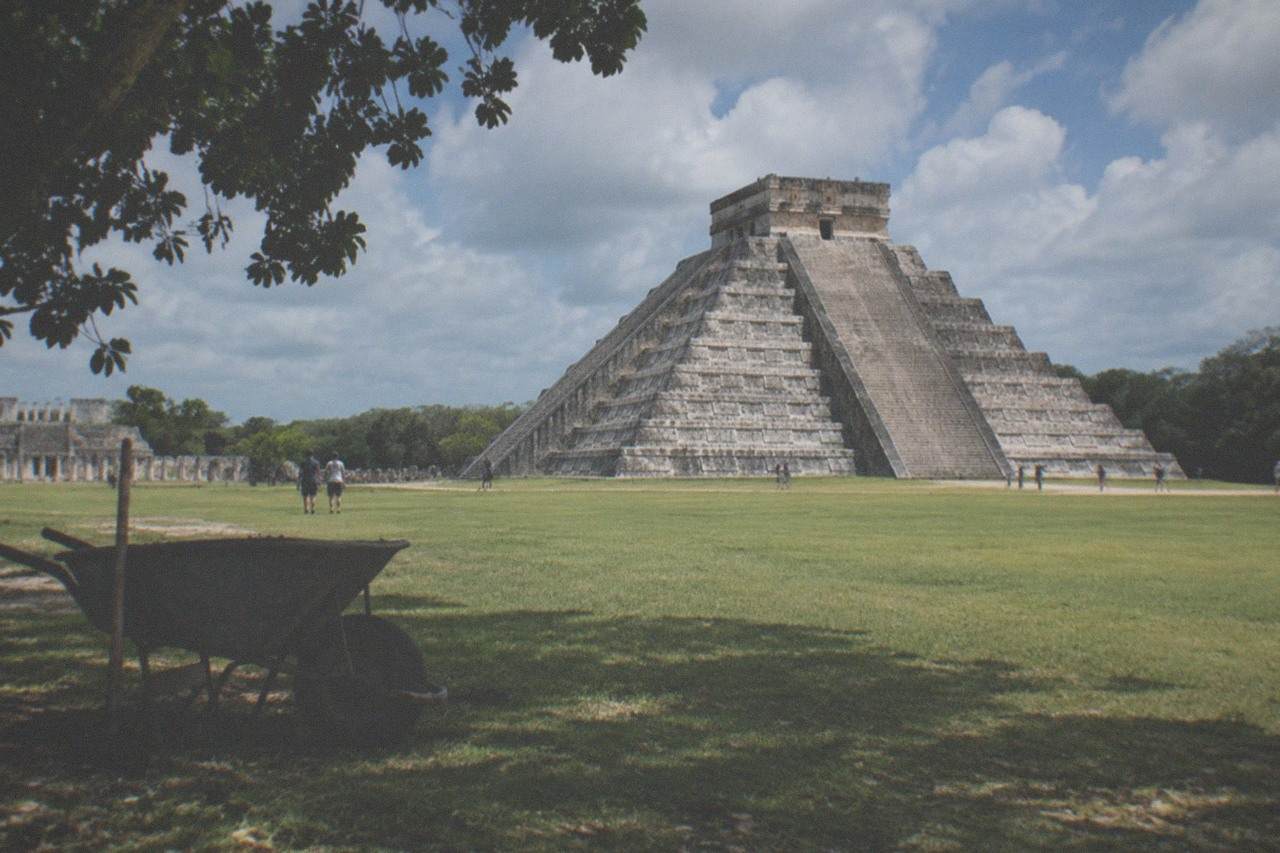
Chichen Itza was named one of the New Seven Wonders of the World in a 2007 global poll because it is the best surviving expression of Maya science in stone: a city whose main pyramid encodes a 365-day calendar, aligns to the sun's path, and stages a light-and-shadow serpent on its staircase twice a year. Its scale helped. The site covers hundreds of hectares of restored temples, ballcourts and causeways in the northern Yucatan, and its best-known structure, El Castillo, rises about 30 meters over the plain. But the poll voters were not simply judging size. They were responding to a building that behaves like an astronomical instrument.
The title itself is worth unpacking, because it is newer than most visitors assume. The "New7Wonders" list was the product of a privately organized worldwide campaign run by the New7Wonders Foundation, which invited the public to vote by internet and phone for monuments from a shortlist of finalists. Chichen Itza made the final seven alongside the Great Wall of China, Petra, the Colosseum, the Taj Mahal, Christ the Redeemer and Machu Picchu. It was the only selection from North America north of Mexico City's boundaries, and it put a Maya site on the same popular footing as monuments with far larger global marketing budgets.
What separates Chichen Itza from other great ruins in Mexico is the density of demonstrable astronomy. The Maya built other cities, but Chichen Itza's builders aligned whole complexes, not just single temples, to horizon events. El Castillo's staircase faces the point where the sun rises on the equinoxes. The El Caracol observatory has sightlines cut through its towers toward the extremes of Venus's path in the sky. The Great Ballcourt's walls carry acoustic properties that still surprise archaeologists. A Wonder of the World, in the poll's logic, is a place human ingenuity made undeniable, and here the ingenuity can still be read off the architecture without a single written sign.
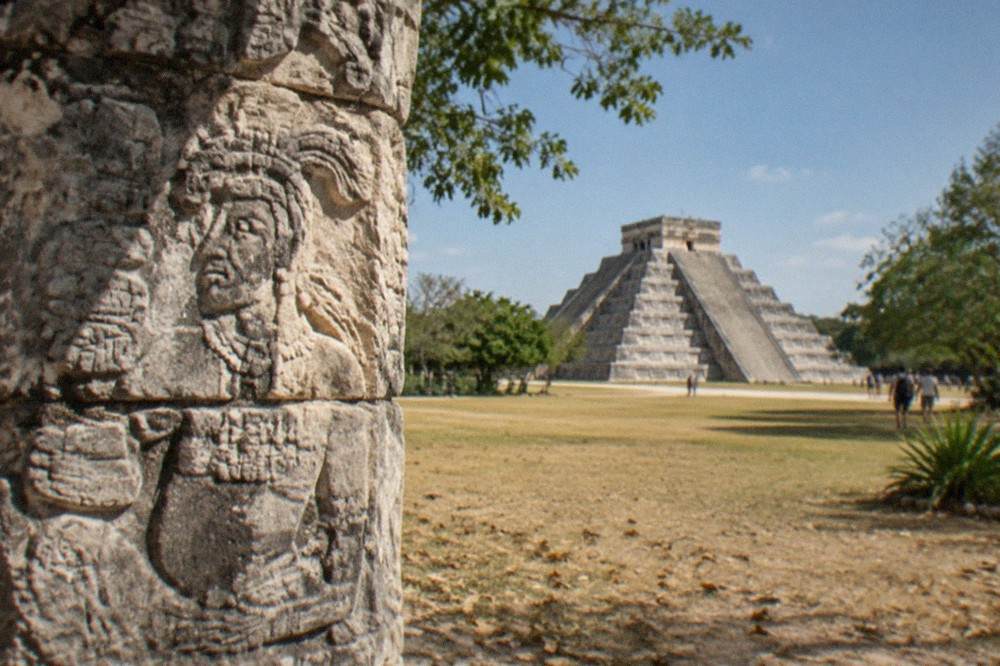
That readable genius is also why the site draws the crowds it does. If you are planning to see it yourself, the small-group early-access format is the one most worth considering, since arrival before the bus fleets is the single biggest quality-of-life factor at the gate.
What Was Chichen Itza Before It Became A Wonder?
Before the modern title, Chichen Itza was a political and religious capital of the northern Yucatan that rose around the 9th century AD, blended Maya building traditions with central Mexican influences, and held the largest ballcourt in Mesoamerica. At its height it governed trade and pilgrimage across the peninsula, and it was already a famous sacred site when the Spanish arrived in the 1500s. The name itself, usually translated as "at the mouth of the well of the Itza," points to the other reason the city exists at all: the region has almost no rivers, and Chichen Itza sits beside deep natural wells, cenotes, that made permanent settlement possible.
The city's decline is as instructive as its rise. Power shifted toward Mayapan and the coastal trading ports sometime in the 13th century, and by the time of the Spanish chronicles the great platforms were partly abandoned. But abandoned did not mean forgotten. Pilgrims kept visiting the Sacred Cenote, and the jungle kept the architecture intact under a low canopy. That long period of quiet, followed by relatively restrained early excavation, is a large part of why the stone survives so well today compared with sites that were quarried for building material.
Modern recognition came in stages. Archaeological work beginning in the 1920s under Mexican and American institutions restored the Great Ballcourt, El Castillo and the Temple of the Warriors. UNESCO inscribed the site on the World Heritage list in 1988, before the popular-vote campaign of 2007 added the New7Wonders label that most casual visitors now associate with it. Both labels describe the same property, but they certify different things: UNESCO recognizes outstanding universal value to humanity, while the New7Wonders list was explicitly a popular celebration.
This history matters for a visitor's expectations. If you want the full story on why the pyramid's interior stays closed to the public, that ban is a separate conservation story covered in why you can't go inside Chichen Itza. The short version for planning purposes: the wonder is best understood from the outside, walking the flattened ceremonial core with a guide who can decode the alignments.
Should you see it as part of a wider loop?
How Does El Castillo Encode A Calendar In Stone?
El Castillo is a calendar built as a building: four stairways of 91 steps each, plus the top platform, total 365, matching the solar year. Its 52 carved panels on each face of the pyramid echo the 52-year cycle of the Maya calendar round. Set a side, the pyramid forms a perfect square aligned to the cardinal directions, and a second, older pyramid sits entirely hidden inside it. That nested structure is the detail that convinces most skeptics. Archaeologists found that the pyramid visible today was built over an earlier one, and that inner temple's chambers remain physically intact inside the mass. In Mesoamerican practice, building over a predecessor was both renovation and consecration, and at Chichen Itza the result is a ruin inside a Wonder.
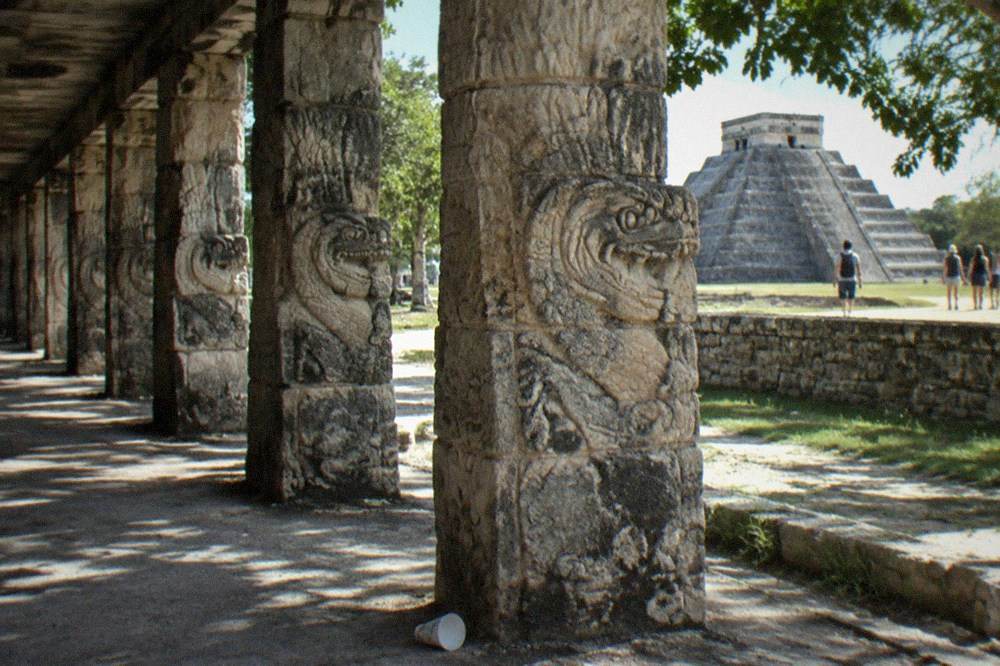
The numbers keep coming when you look at the surrounding layout. The Great Ballcourt's playing field is the largest known in Mesoamerica, bounded by high walls with carved reliefs of the ballgame and its ritual consequences. The Temple of the Warriors is flanked by hundreds of square columns, each carved with a warrior figure. The Sacred Cenote, a wide sinkhole about 30 meters across, sits at the end of a raised causeway and yielded offerings of gold, jade and copal resin from dredging campaigns in the early 20th century. A site that engineers a road specifically to a well, and decorates the road's end with a shrine, is telling you what it valued.
For readers comparing it to other peninsula ruins, the contrast with Coba is useful. Coba was a sprawling low city of causeways and a pyramid you could still climb until recently, and the official INAH listing for the site notes foreign entry at 210 MXN, nationals 105 MXN. Chichen Itza is denser, more restored and far more symbolically loaded. That density is exactly what a small-group early-access tour exploits well: the Chichen Itza, Cenote Ik Kil and Coba small-group tour, rated 4.5 from 987 reviews and from $165, covers the Wonder plus the two neighboring experiences in one long day.
What Is The Equinox Serpent?
The equinox serpent is a shadow effect on El Castillo's north staircase: on the afternoons around March 20-21 and September 21-23, the sun's angle casts a series of triangular shadows that connect into a zigzag "serpent" descending toward the carved stone snake heads at the base. The effect peaks for roughly 30-45 minutes in the late afternoon, and it is visible, weather permitting, for several days either side of the exact date. The alignment is precise enough that archaeologists treat it as intentional, not coincidental. The staircase's balustrades end in stone serpent heads at the bottom, so on those two afternoons the building appears to summon a diamond-backed rattlesnake, the imagery of Kukulkan, the feathered serpent deity the Maya shared with central Mexican cultures under other names.
Crowd behavior around the equinox is its own phenomenon. The spring date in late March falls in dry season and draws very large gatherings, while the autumn date in late September, deep in rainy season, draws significantly fewer visitors for the same effect. Cloud cover can and does wipe out the show entirely in September, which is the honest trade-off. Either way, tour operators run special departures, and the site has in the past extended operations on peak days. The effect is also observable with the naked eye from the main esplanade; there is no special ticket, only the standard admission. The full index of guides sits on Tours in Playa del Carmen.
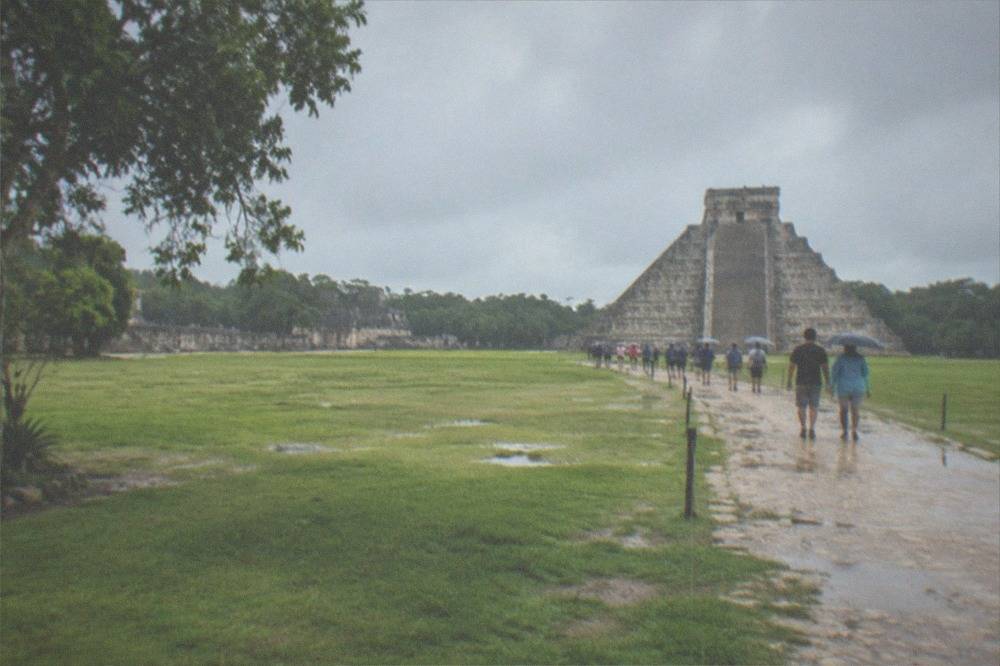
One planning note: because the serpent appears in the late afternoon, equinox visitors effectively commit to a full day at the site, arriving early to beat crowds and staying past 3 PM. Most standard tours from the coast are built around morning visits and return by early evening, so equinox travelers should check the return time on the operator's live listing before booking. A good primer on choosing among the options is the Chichen Itza tours from Playa del Carmen guide, which breaks down the transport formats.
Can You Still Climb The Pyramid?
No. Climbing El Castillo has been prohibited since 2006, after a visitor fell and died, and the ban was extended to the site's other major structures by 2008. Barriers and a minimum viewing distance of roughly 15 meters, reinforced in 2025, are actively patrolled, and violations can mean removal from the site, fines or legal action. The interior rooms, including the famous Red Jaguar Throne chamber inside the upper temple, are closed as well. This is a real change from the memories many returning travelers carry: for decades the pyramid was climbable, and the red jaguar altar was briefly visitable on an interior stair.
The policy is not arbitrary gatekeeping. Millions of footsteps erode limestone steps quickly, and the platform edges are unforgiving. The viewing rules preserve the structure for the next century of visitors, which is precisely the reasoning that UNESCO and Mexican conservation authorities apply across the peninsula's major ruins. Tulum, for example, long ago roped off its cliffside temples for the same reason.
Visitors who specifically want a climbable pyramid experience on the same trip have historically looked to Coba, though access rules there have also tightened over the years, and the current rules should be confirmed on-site or with your operator. The honest framing for a Chichen Itza visit today is a walking circuit of the ceremonial core: El Castillo from the esplanade, the ballcourt, the Wall of Skulls platform, El Caracol and the Sacred Cenote. Guides add the decoding, and a good one turns a two-hour walk into the reason the place earned its title. Travelers with only a tight window can still see the essentials, a question covered in detail in whether 2 hours is enough for Chichen Itza.
How Much Does It Cost To Get In?
Foreign adult visitors pay a combined total of roughly 676-697 MXN, about $35-40 USD, split between an INAH federal fee of roughly 105 MXN and a Yucatan state fee of roughly 571-592 MXN, collected at separate windows at the entrance. Mexican nationals pay roughly 272-310 MXN with ID, Yucatan residents often only the INAH portion, children under 13 are typically free or pay a reduced rate, and Mexican citizens enter free on Sundays with valid ID. The two-window system is the detail that catches people out: paying only the first fee does not get you through the second gate.
| Visitor category | Approximate combined entry | Notes |
|---|---|---|
| Foreign adult | 676-697 MXN | Split across INAH and state windows |
| Mexican national with ID | 272-310 MXN | Weekday rate with INE or equivalent |
| Yucatan resident | ~105 MXN in some reports | Often INAH portion only |
| Children under 13 | Free or ~105 MXN | Confirm at the gate |
| Mexican nationals on Sundays | Free | Valid ID required |
The fee structure was adjusted effective January 1, 2026, following annual reviews of the federal rights schedule, and Mexican press coverage tracks the changes each year, with Por Esto's fee report for 2026 being a reliable local reference. Since the totals cluster close to 697 MXN in recent reporting, treating anything quoted as a single hard figure with mild suspicion is reasonable until you are at the window.
Most organized tours from Playa del Carmen bundle entry into the headline price, which is one honest reason tours look expensive against a raw ferry of fees. The question of whether the site is even open has also been a live one recently, and the answer is covered in is Chichen Itza closed.
How Do You Visit Chichen Itza From Playa Del Carmen?
Chichen Itza sits about 182 km, roughly 113 miles, from Playa del Carmen via the toll roads, and the drive takes about 2 to 2.5 hours one way under good conditions. Full-day guided tours from Playa run 10-11 hours total, typically departing around 7-8 AM and returning by 5:30-6:30 PM, usually with a cenote stop and lunch built into the day. The site itself opens daily from 8 AM to 5 PM with last entry at 4 PM, and the single biggest lever on your experience is which end of the day you spend there. Arriving at opening puts you ahead of the bus fleets from Cancun and the coast, which land mid-morning; the quietest weekdays are Tuesday and Wednesday.
The transport formats are worth separating, because they differ more than their prices suggest. A shared coach tour is the cheapest and longest day. A small-group tour trims the group size and usually adds early access or a second ruin. A private tour gives you the schedule. Self-driving is entirely feasible on Highway 180D/305, and the toll road is fast, but you then handle entry fees, parking and the guiding yourself.
| Tour format from Playa | Starting price | Best for |
|---|---|---|
| Shared coach with buffet, from $93 | Valladolid and cenote combo | Budget, first-time visitors |
| Small group with early access, from $165 | Coba plus Cenote Ik Kil | Fewer crowds, two sites in one day |
| Deluxe full-day, from $115 | Comfort transport | Travelers who want a softer schedule |
The trio above maps onto three of the strongest listings in the roster. The Chichen Itza, Valladolid and cenote tour with buffet is the volume leader at 4.5 from 954 reviews, from $93. The deluxe full-day option runs 4.7 from 251 reviews, from $115. The small-group early-access format that pairs the pyramid with Coba and Cenote Ik Kil carries the deepest review record of the three at 4.5 from 987 reviews, from $165. For travelers who want the lightest possible schedule, there is also a dedicated early tour with an expert guide, 4.4 from 98 reviews and from $77, which skips the cenote stops and gets you back to the coast sooner. Check availability
Common Questions About Chichen Itza
Why Is Chichen Itza A Wonder Of The World?
It was voted one of the New Seven Wonders of the World in a 2007 global poll, on the strength of its astronomical alignment, its calendar encoded in El Castillo's 365 steps, and the survival of an entire ceremonial city from the Maya classical era.
Can you climb El Castillo?
No. Climbing has been prohibited since 2006 and enforced across the site's major structures since 2008, with barriers, a minimum viewing distance and patrol staff. Violations can lead to removal or fines.
How much is entry for foreign visitors?
Roughly 676-697 MXN combined, about $35-40 USD, split across a federal INAH window and a Yucatan state window. Children under 13 are typically free or pay a reduced rate.
When is the serpent shadow visible?
Around the spring equinox on March 20-21 and the autumn equinox on September 21-23, in the late afternoon for roughly 30-45 minutes, weather permitting. The effect is visible for several days either side of the exact date.
How long does it take to get there from Playa del Carmen?
About 2 to 2.5 hours each way by road, roughly 182 km. Most organized day tours run 10-11 hours door to door with pickup around 7-8 AM.